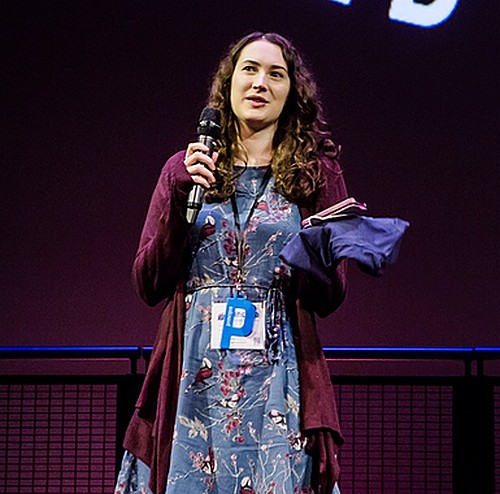
Our speaker at this meeting is Dr Sophie Murray, currently a Research Fellow at TCD where she works on Space Weather projects within the Astrophysics Research Group. She has previously worked with the Met Office on Solar Physics and Thermospheric Modelling projects.
Dr Murray has over ten years experience as a research scientist, analysing and visualising large volumes of satellite data, and developing and verifying modelling techniques. Her current research interests range from solar flares and active regions to the impact of space weather on the Earth's upper atmosphere.
Space weather describes the changing environmental conditions in near-Earth space. Severe space weather events in the form of solar flares, coronal mass ejections (CMEs), and solar energetic particle events, have the potential to severely affect a range of vital technologies. It is thus crucial to improve our scientific understanding of solar storms and the Sun-Earth connection in order to provide accurate forecasts of severe events.
Doors open about 7.15pm. There is free parking available on the campus in the evenings. Admission Free, including light refreshments. We are located in the Bell Theatre, Department of Mathematics and Physics, QUB – details here……
With thanks to the Astrophysics Research Centre, QUB, for assistance with this event.
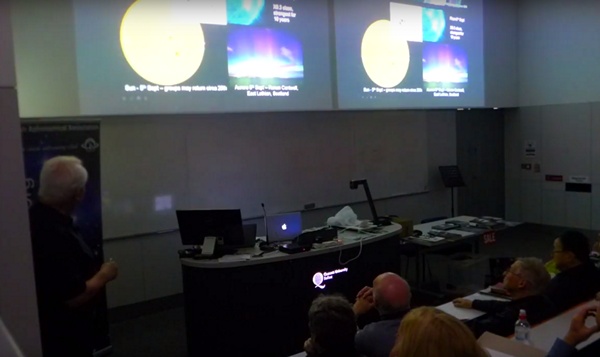
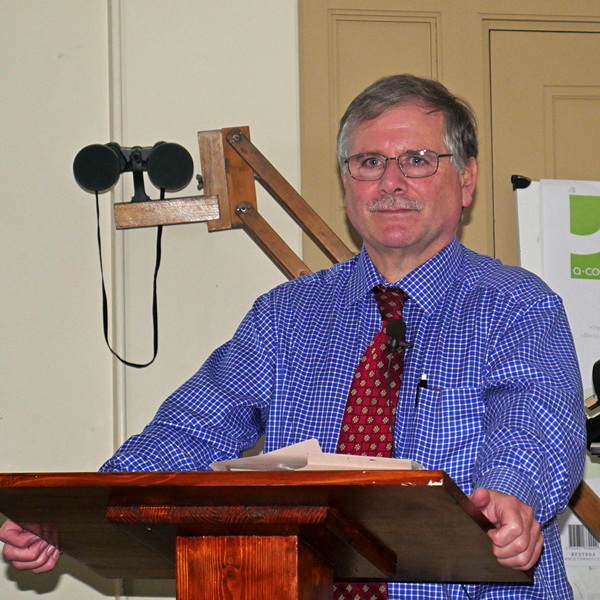
For those of you who couldn't make it, here's the Introductory part of Wednesday's Season Opening meeting including highlights of the Summer, an outline of the first half of the coming season, a look at the Night Sky, and the presentation of the Aidan P Fitzgerald Medal to speaker Professor Mark Bailey!
A bright comet can become the most prominent object in the sky other than the Sun and Moon and a source of wonderment and awe for those lucky enough to see one. This talk begins with an introduction to comets, their origin and proximate source in the Oort cloud; and then discusses evidence for exceptionally large, so-called "giant" comets with diameters 50km to 100km or more.
Such an object can be expected to arrive in the inner solar system at intervals of the order of 50 to 100 thousand years, and debris from their evolution may produce a very much more "active" sky than that experienced today.
Evidence for the arrival of the most recent giant comet some 10 to 20 thousand years ago suggests a possible explanation for mankind's early interest in the sky, a powerful motivation for the erection of monuments with astronomical associations, and the origin of religion.
Doors open about 7.15pm. There is free parking available on the campus in the evenings. Admission Free, including light refreshments. We are located in the Bell Theatre, Department of Mathematics and Physics, QUB – details here……
With thanks to the Astrophysics Research Centre, QUB, for assistance with this event.