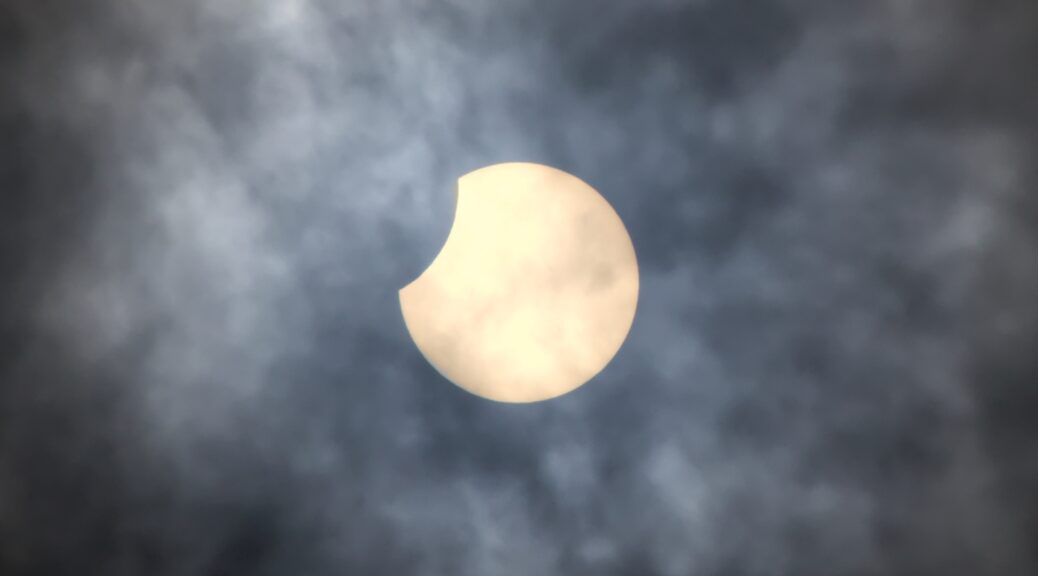
OBSERVING A PARTIAL SOLAR ECLIPSE.
This eclipse starts at about 10.05, reaches its maximum of about 25% at 10.50, and ends at about 11.40. It will be noticeable from about 10.15 to about 11.30.
Firstly, you should NEVER look directly at the Sun with the naked eye (or specs!), and ESPECIALLY NOT with any sort of optical equipment such as telescopes or binoculars – to do so risks serious permanent eye damage.
But there are several ways to observe this event safely.
1. Pinhole projection. Make a pinhole or needle-hole in a piece of card, such as a piece of a cereal packet. Hold that up at right angles to the Sun and let it shine through the hole onto another piece of white card held a few inches behind it. You’ll see a round image of the Sun with a small ‘bite’ out of it, caused by the Moon passing in front of the Sun. Do NOT look at the Sun through the pinhole! The larger the hole, the brighter the image, but the fuzzier it will be. About 1mm diameter is probably best.
2. If you have a small refractor type telescope mounted on a tripod, keep the cap on the lens at the front, and on any finder telescope attached to it. Insert the lowest power / widest angle eyepiece you have (usually the one with the largest number in mm marked on it, e.g 25mm), remove any cap from the eyepiece, and position a piece of white card behind the eyepiece. Adjust the angle of the telescope so that its shadow on the card is smallest, which means it’s pointed roughly at the Sun.
If there’s a finder, remove the cap, but don’t look through it! Make fine adjustments to the pointing of the telescope until you see a small image of the Sun projected onto the card.
Then, or if there’s no finder telescope attached, remove the cap from the front of the telescope, and move it in fine adjustments until an image of the Sun appears projected onto the card. Put the cap back on the finder for safety. Then use the focus knob until that image is as sharp as possible.
Remember, NEVER look through either the finder or the telescope while doing this.
And don’t leave the telescope unattended, in case someone else tries to look through it.
3. If you have a pair of special eclipse glasses left over from previous solar events you can use them, provided there are no holes or scratches in them. To test them, look at the brightest light in your house through them – you should see absolutely nothing, except possibly the filament itself in a very bright (100W+) incandescent light bulb!
4. If you have access to the darkest grade of Welder’s glass (14), you can use that, but no other sorts of filters are safe.
Do NOT use 3D glasses, CDs, DVDs, mylar type film, e.g. from packaging or the interior of wine boxes etc. Not even multiple pairs of sunglasses are safe, as they may let through harmful UV radiation.
But if you can just barely see the Sun through thick fog or cloud, you can look at that for short periods, but if it starts to brighten so you can see it clearly, look away.
Further information and guidance can be found here https://www.space.com/15614-sun-observing-safety-tips-infographic.html