

IAA Lecture Weds 26th Nov 1930 Larmor Theatre, QUB

“How Solar Flares Affect the Atmosphere of Our Planet”. by Dr Susanna Bekker, Astrophysics Research Centre, QUB

Abstract:

Solar flares are among the most powerful energy releases in the Solar System: a single flare can emit as much energy as humanity consumes in a million years. Unsurprisingly, such enormous events leave detectable signatures at Earth, despite the vast distance between us and the Sun. Solar flares produce a wide range of atmospheric effects, from beautiful phenomena such as auroras to less pleasant consequences such as radio blackouts, navigation errors, and disruptions in satellite operations.

As we are at the peak of Solar Cycle 25, it is especially important to understand how the Earth’s atmosphere responds to these events and how long it takes to recover afterward. This talk will review the various impacts of solar flares and provide insight into our ongoing efforts to investigate these phenomena and improve our ability to predict them.

Bio:

I earned my PhD at the Moscow Institute of Physics and Technology (MIPT) in 2019, where I studied and modelled the behaviour of the Earth’s lower ionosphere under both quiet conditions and various natural disturbances. In 2023, I joined the Astrophysics Research Centre at Queen’s University Belfast as a Research Fellow. By combining my geophysical background with the expertise of outstanding astrophysicists, the QUB solar flare group has identified and evaluated several previously unrecognised Sun-Earth interaction effects. We continue to investigate the full chain of processes, from the generation of solar emissions on the Sun to the disturbances they produce in the Earth’s atmosphere.
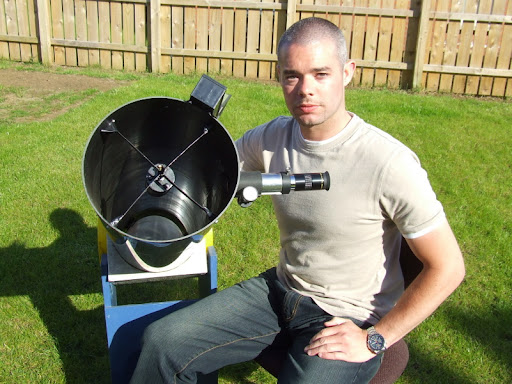
 IAA LECTURE Wednesday 12 November, 7.30 p.m. Larmor Lecture Theatre, Physics Building, QUB: “NIGHT SKY HUNTING” by Martin McKenna

ABSTRACT

The talk will be part biography and part sky phenomena. Martin will describe how Comet Hale-Bopp first got him into astronomy, the development of his observing career and passion, the night I decided I wanted to learn all the stars in the sky, his ever bigger telescopes, comet-hunting], a few close calls and near misses when I came close to making a discovery and didn’t.

   He will then describe recent sky events which have impressed him, the auroras of May and Oct 2024, the NLC display of July 2024, comet NEOWISE of July 2020. Then a very brief change to how he got into storm chasing, the joys of the photogenic challenges it brings. The talk will end with a brief look at comet Lemmon to show he’s still into comets as much as ever

Brief Bio: 

Martin McKenna is an amateur astronomer and photographer from N. Ireland. After witnessing great comet Hale-Bopp in 1997 his life changed forever. He quickly developed a passion for the stars and for comets in particular and spent over ten years searching the skies for a new comet of his own. Martin has a particular interest in transient events and enjoys photographing the aurora borealis and noctilucent clouds. His passion for the sky also has evolved to daytime events such as atmospheric optics and convective weather events. Currently he splits his time between visual observations of the sky using his 10″ telescope and photographing dramatic sky events with the intention of documenting memories and creating time lapse video sequences covering everything from a pulsating corona to an explosive updraught on a thunderstorm. He currently lives in Mid-Ulster and enjoys the dark skies from the Sperrins.

Martin has had the honour of having an asteroid named after him: 42531 McKenna.  He was also awarded ‘Irish Astronomer Of The Year 2005’ by the Irish Federation Of Astronomical Societies. He is one of the most enthusiastic, dedicated, and indefatigable observers you will ever meet.