
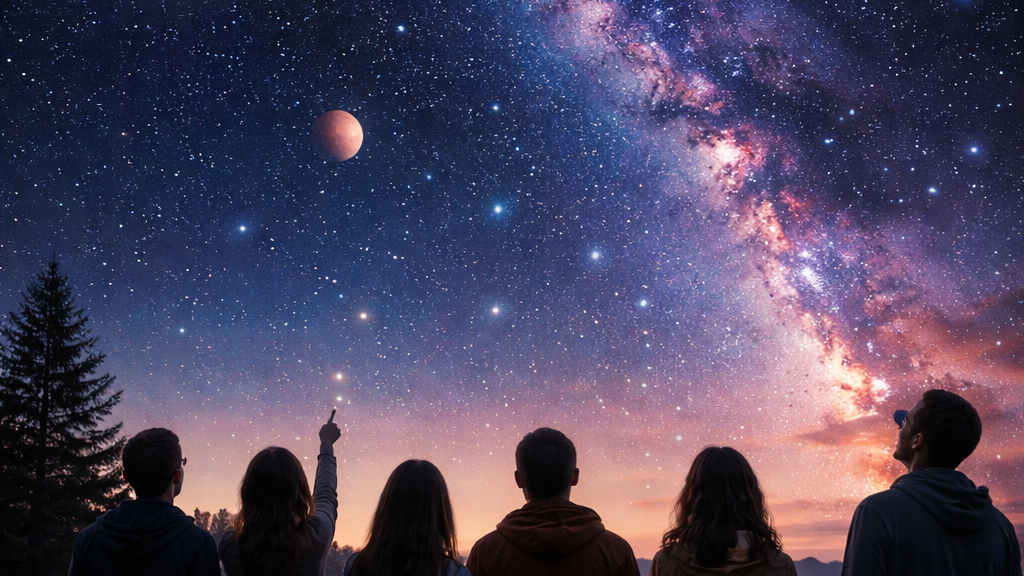
We will be holding a public / outreach observing event at the car park, Seapark, Co Down, on Wednesday evening as part of IRISH ASTRONOMY WEEK.
All welcome. Come along, and bring a telescope or binoculars if you have them, We’ll observe a beautiful First Quarter Moon, Venus, Jupiter, and the Pleiades, Orion Nebula, etc. See the amazing performance of the new Seestar Smart telescopes.
ACCESS. Seapark Road, off the Holywood Bypass / Bangor Road, then Right into Ballymenoch Pk. Going from Belfast direction, go past the traffic lights at Holywood, then next left just as the road starts to climb uphll. The car park is at N 54.64705, W -5.82662.
All posts by iaaadmin
IAA LECTURE: Wednesday 18 March, 7.30 p.m. Larmor Lecture Theatre, Physics Building, QUB”Exo-rings and Exo-comets” by Dr Ernst de Mooj, Astrophysics Research Centre, QUB
SYNOPSIS
Over the past 30 years, we have discovered thousands of exoplanets, but at the same time we have also started to find other objects around these stars, including exo-comets and giant exorings, some of which might be one astronomical unit across. I will discuss some of these strange objects, how we find them and how we can investigate them.
Brief biography
Dr. Ernst de Mooij is a Senior Lecturer at Queen’s University Belfast. He obtained his PhD from Leiden University, after which he became a postdoctoral researcher at the University of Toronto. Subsequently he moved to Queen’s University Belfast as the Michael West Fellow, following on from that he was an assistant professor for 3 years at Dublin City University.
His research is focused on the characterisation of exoplanets, focusing in particular on their atmospheres and the circumplanetary environment, including exorings. He has also been investigating exo-comets, particularly those orbiting beta Pictoris.

IAA LECTURE: Wednesday 4 March, 7.30 p.m. Larmor Lecture Theatre, Physics Building, QUB: “The Keplerian revolution – measuring the brightness of stars from space” by Dr Gavin Ramsay, AOP:
Abstract:
Astronomers can be frustrated by bad weather and day-light when trying to make observations of celestial sources. Within the last 20 years a series of satellites have been launched allowing astronomers to obtain virtually uninterrupted observations of stars lasting months or even years. I will outline some of the results from these observations which have allowed us to probe into the core of stars and the discovery of thousands of planets orbiting other stars.
Bio:
Gavin obtained his PhD in X-ray observations of accreting binary stars from UCL’s Mullard Space Science Lab, after which he spent two years at the University of Utrecht in the Netherlands. Returning to MSSL for more than ten years, he then moved to Armagh Observatory. His interests include accreting binaries, stellar activity, transients and exo-planets and uses multi-wavelength observations from radio to X-ray bands. He is the Community Scientist for ESA’s Plato mission due to be launched early in 2027.

IAA LECTURE for NISF: Wednesday 18 February , 7.30 p.m. Larmor Lecture Theatre, Physics Building, QUB: “Challenges and the Potential Scientific Return from Building the Largest Telescope in the World – A Colossus Turns Its Eye on the Sky”
Constructing the largest telescope in the World, bigger than the Colosseum and high up in the Andes Mountain, has proven to be challenging. It is however already well on its way and promises us images of Earth-like planets around nearby stars, the ability to search for signs of life in their atmospheres and an understanding of how the first galaxies formed.
In this talk, Professor Tom Ray, President of the European Southern Observatory, will explain how engineers and astronomers have overcome the difficulties in building such a colossus and what it can do to help us unravel the birth of the Universe and address the age-old question of whether we are alone.

IAA LECTURE Wednesday 4 February , 7.30 p.m. Larmor Lecture Theatre, Physics Building, QUB
Unfortunately due to circumstances outside our control, the lecture by Dr Ernst de Mooj has had to be rearranged for March 18.
We are extremely grateful to one of our past Presidents, Paul Evans, for stepping in at a day’s notice to give us an alternative lecture on the latest on NASA’s Artemis Mission to the Moon.
This is very timely, with the first human-crewed mission to the Moon for over 50 years due to launch within the next month or so. This is an updated version of a very popular talk that Paul has already given to various groups. So it promises to be fascinating!
The meeting will begin with a short address by NI STEM Ambassador Manager, Dr Hanagh Winter.
VENUE: Larmor Lecture Theatre, Astrophysics Research Centre, Physics Building, QUB.
Admission free, including light refreshments, All welcome.
IAA Lecture 21st January 7:30pm, Larmor Theatre, QUB-
“The Nitrogen Crisis in the Early Universe” by Dr Jorick Vink, Senior Research Astronomer at Armagh Observatory & Planetarium,
Synopsis
Nitrogen is one of the key elements for life, yet its origins in the early Universe remain surprisingly uncertain. Recent observations of very distant galaxies with the James Webb Space Telescope have revealed unexpectedly high levels of nitrogen — levels that are difficult to explain with our standard ideas about how stars form and evolve. In this talk, I will explain where nitrogen is thought to come from, why these new discoveries pose a serious challenge to our current understanding, and how new insights into the lives of massive and very massive stars may help to solve this cosmic puzzle.
Brief biography
Jorick Vink is an Astrophysicist at Armagh Observatory & Planetarium, where he studies some of the most massive stars in the Universe and their role in shaping galaxies over cosmic time. He is Principal Investigator of the ESO Large Programme X-Shooting Ulysses: Massive Stars at Low Metallicity, and combines observations from major telescopes with theoretical models to understand how massive stars evolve and how they produce heavy elements and black holes.
IAA Lecture Wednesday 7th January 2026 19:30 – Larmor Theatre, QUB, Prof Stuart Sim
“Kilonovae and the origin of the heavy elements”
Synopsis:
It is generally agreed that only hydrogen and helium were present in significant quantities immediately after the Big Bang, and so the question of how astronomical objects have created all the heavier elements has been a longstanding topic of research. In particular, the origin of the heaviest elements (those beyond the iron group) has been particularly difficult to explain. New insights on this have emerged in recent years thanks to the first clear identifications of astronomical explosions associated with the mergers of neutron stars, so-called “kilonovae”: these transients have been found thanks to advances in “multi-messenger” astrophysics, in which gravitational wave detectors and satellite telescopes (including gamma-ray and infrared observations) have made it possible to find and study these events. I will discuss our progress in the study of kilonovae, particularly efforts at Queen’s and elsewhere to understand the role they play in creating the heavy elements.
Bio:
Originally from the north east of Scotland, Stuart Sim studied at the University of Oxford (1995 to 2002) before working as an astrophysics researcher in London, Munich and Canberra. Since 2013 he has been a member of the Astrophysics Research Centre and Queen’s University Belfast where he was made professor of theoretical astrophysics in 2024. His research is focussed on studying astrophysical explosions, including supernovae and kilonovae, with an emphasis on using computer simulations to interpret data and understand the physics that undermines these phenomena.
VENUE: Larmor Lecture Theatre, Astrophysics Research Centre, Physics Building, QUB.
Admission free, including light refreshments, All welcome.
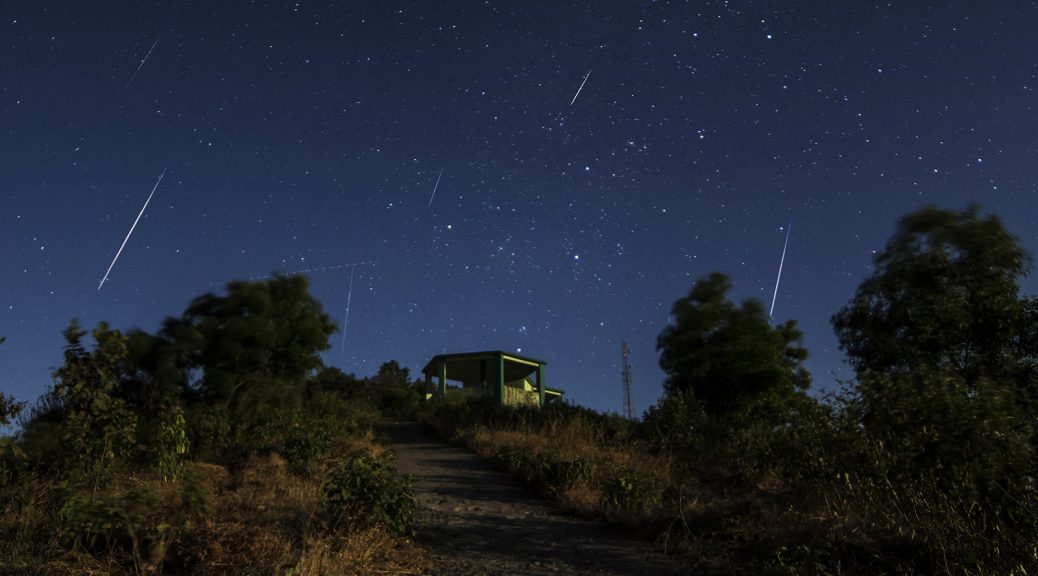
GEMINIDS meteor shower observing event BROUGHT FORWARD TO TONIGHT, FRIDAY
Because of the weather forecast, the event on Saturday evening is being brought forward to tonight, Friday, All other details remain more or less the same.
The Geminids peak Sat. & Sun. 13/14 December. To observe these, we have planned an event at the foot of Sketrick Castle, adjacent to the Outdoor Activities Centre. All are welcome, no booking required, details below.
. The meteors are fast (70km/second) and often bright, usually white but occasionally yellow, green, red or blue. In perfect conditions up to 120 per hour can be seen though we might realistically hope to see between 15-30. At least one yellow tabard-clad IAA council member will be there with a laser pointer to point out the constellations and planets and provide more information on the shower.
Daft Eddy’s pub and restaurant have kindly agreed to let us use their car park which is adjacent. Eating and drinking there is not part of the organised evening but if anyone would like to eat there then do book as it’s very busy at this time of year. If any members would like to buy drinks (including non-alcoholic ones for preserving your best eyesight and the ability to drive home!) that would be a nice way to thank them for the car park use. Toilets are available too. Daft Eddy’s restaurant is open until 21:00 and the pub until around midnight.
Parking: Daft Eddy’s at Sketrick Island (veer right then left after crossing the causeway) the park is always open: https://maps.app.goo.gl/aHCZCb1VWz9fvoLi6.
The overflow car park if required is the public park at Whiterock, 400m away at https://maps.app.goo.gl/zGQuNBaH6TMkgjXN8, note that the toilets there will be closed. Bring a torch for the short walk on the unlit road if using this.
Observing: At the foot of Sketrick Castle at the end of the causeway immediately adjacent to Daft Eddy’s https://maps.app.goo.gl/5JRTQLZ52rRuNPuA7.
Time: 20:00-midnight, though it is fine to arrive or depart at any time including before or after the given times. The shower is likely to improve gradually as time goes on until the moon rises.
What to bring
Extremely warm clothes/gloves/hat as it will be pretty Baltic! Snacks/hot drinks. You can warm up at the Daft Eddy’s bar with a drink if needed! Despite it being a dead end with few and slow cars, the observing space is next to a road so brightly coloured or reflective things are strongly recommended. Optionally, a camping or deck chair is recommended for comfortable observing, while a reclining sun lounger with hot water bottle filled from a flask is the deluxe option for gazing skyward! Optionally bring binoculars to look at Jupiter/Andromeda Galaxy/Orion nebula and lots more.
Daft Eddy’s Bar & Restaurant, 1 Sketrick Island, Killinchy, Newtownards, BT23 6QH 54.488009 -5.647926
IAA Lecture, Weds 10th December 1930, Larmor Lecture Theatre, QUB
“Observing Asteroid Occultations from a Remote Observatory” by Michael O’Connell
Brief Synopsis:
Occultations are essentially mini-eclipses where a planetary body (such as the Moon, planet or asteroid), blocks the light of a star or other stellar target from reaching the Earth. The dip in the light curve due to this shadow effect can be analysed to tell us something about the planetary body or the stellar target itself. Michael’s talk aims to present some of the basics of observing occultations and the results derived therefrom. Michael will also explain how he is using his equipment in a remote observatory in Spain to pursue these observations.
Bio:
Michael is an amateur astronomer residing in Co. Kildare. Michael is a former chairperson of the Irish Federation of Astronomical Societies (IFAS) and Midlands Astronomy Club (MAC).
Aside from observing occultation events, Michael is also an active solar observer, member of the BAA, and operates 3 meteor cameras from his home as part of the Global Meteor Network (GMN).
Michael has previously presented to the IAA on the topics of ‘The Antikythera Mechanism’ and ‘Amateur Observations of Meteors’.
Venue: Larmor Lecture Theatre, Astrophysics Research Centre, Physics Building, QUB.
Admission free, including light refreshments, All welcome.
IAA Lecture Weds 26th Nov 1930 Larmor Theatre, QUB
“How Solar Flares Affect the Atmosphere of Our Planet”. by Dr Susanna Bekker, Astrophysics Research Centre, QUB
Abstract:
Solar flares are among the most powerful energy releases in the Solar System: a single flare can emit as much energy as humanity consumes in a million years. Unsurprisingly, such enormous events leave detectable signatures at Earth, despite the vast distance between us and the Sun. Solar flares produce a wide range of atmospheric effects, from beautiful phenomena such as auroras to less pleasant consequences such as radio blackouts, navigation errors, and disruptions in satellite operations.
As we are at the peak of Solar Cycle 25, it is especially important to understand how the Earth’s atmosphere responds to these events and how long it takes to recover afterward. This talk will review the various impacts of solar flares and provide insight into our ongoing efforts to investigate these phenomena and improve our ability to predict them.
Bio:
I earned my PhD at the Moscow Institute of Physics and Technology (MIPT) in 2019, where I studied and modelled the behaviour of the Earth’s lower ionosphere under both quiet conditions and various natural disturbances. In 2023, I joined the Astrophysics Research Centre at Queen’s University Belfast as a Research Fellow. By combining my geophysical background with the expertise of outstanding astrophysicists, the QUB solar flare group has identified and evaluated several previously unrecognised Sun-Earth interaction effects. We continue to investigate the full chain of processes, from the generation of solar emissions on the Sun to the disturbances they produce in the Earth’s atmosphere.