
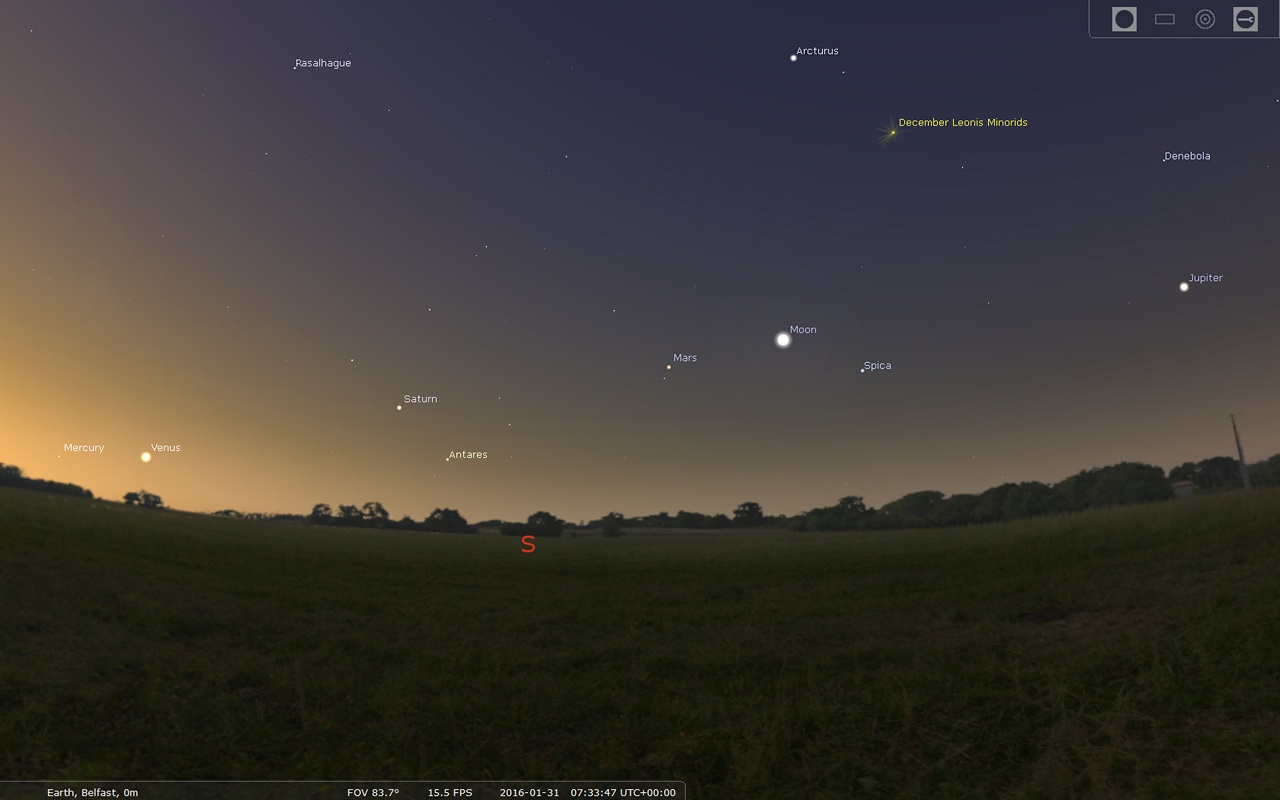
See All Five Naked Eye Planets at Once

From 24th January to about 6th February, you have a rare chance to see all five naked eye planets at once in the morning sky.
 
 
Looking from left to right, or East to West, they will be: Mercury, Venus. Saturn, Mars, Jupiter.
 
The latter 4 are easy to see, just before the dawn sky brightens. But we have to wait until about 24th Jan  to first glimpse elusive little Mercury, which is always the hardest to see:
 
Mercury will be easiest to see from about 28th Jan to 2nd Feb, but you can start looking from about 24th Jan in case the skies are cloudy later. The group will be joined by the waning crescent Moon from 31st January.
 
You should start looking from about 45 minutes before sunrise, say about 07.30, and you'll need a good clear view right down to the horizon in the South East.
 
Venus will be by far the brightest, a brilliant beacon above the SE horizon. Look about a handspan to the left of Venus, and slightly below it, to try to spot Mercury, which will be much fainter, and not easy to find in the twilight glow. Use binoculars to find it at first if you have them.
 
Once you've found Mercury, go back to Venus, and then follow that line across the sky to find Saturn (quite bright, creamy white), Mars (moderately bright, reddish) and Jupiter, the second brightest, and white). Altogether they will span more than halfway across the sky.
 
The group will be joined by the waning crescent moon from 1 February onwards, making an even more glorious sight. The Moon will be close to Mars on 1st Feb , and will form a nice triangle above Venus and Mercury on 6th Feb.
 
And there will also be 2 bright stars in the line-up as well! Lovely blue-white Spica will lie between Mars and Jupiter, and noticeably red Antares will lie below right of Saturn.
 
A sight not to be missed!

Lecture Weds 20th January, 7.30 p.m. – Dr Heather Cegla (QUB) – “Discovering Alien Worlds”

This talk, by Dr Heather Cegla, of the Astrophysics Research Centre at QUB, will give a brief overview of the first ever confirmation of planets outside our solar system, the two main exoplanet detection methods, some stumbling blocks on the pathway to confirming an extra-solar Earth-analogue (which is her area of expertise), and discuss some prospects for the future and the efforts we’re taking to discover habitable alien worlds. 

Doors open about 7.15pm. There is free parking available on the campus in the evenings. Admission Free, including light refreshments. We are located in the Bell Theatre, Department of Mathematics and Physics, QUB – details here……
 
With thanks to the Astrophysics Research Centre, QUB, for assistance with this event.

Wonders of the Night Sky – Fri 15th Jan – St. Patrick’s Academy, Dungannon

Astronomy Observation evening at
 
 
Friday 15th January 7:00-9:00pm
 

Features will include:-

Guided starshows in a mobile planetarium (courtesy of Armagh Planetarium), 

See the school observatory and observe the night sky through the telescope

Talk to amateur astronomers

Telescope workshops


Free Admission, All Welcome


Free Astro Calendar from IFAS!

Unfortunately due to circumstances beyond our control it was not possible to get the IFAS Astronomy Calendar printed in time for distribution this year, so rather than waste the effort already put in, the IFAS Committee have decided to distribute the calendar for download free of charge.

This is an excellent piece of work with time-critical astronomical information written from an Irish perspective and many thanks are due to John Flannery for the many hours he has spent pulling this together.

Note that for copyright and size reasons this free edition does not include the images that were to be part of the printed version.

The Calendar can be downloaded from this link….

Lecture Weds 6th January, 7.30 p.m. “When Earth encounters interplanetary matter: Bananas, Wings and Totoro”, by Dr David Asher, Armagh Observatory

Dr David Asher is an expert on the dynamics and orbits of objects in the Solar System, and how they interact with each other and the Earth.
 
He recently appeared on BBC TV (above) highlighting the potential danger posed to Earth by "Centaur" objects – giant comets in the outer solar system of which hundreds have been discovered in recent years.
 
We are delighted to welcome David back as a speaker; he has given us some fascinating lectures over the years, with intriguing titles, and this one is no exception! To find out what it's all about come along on Weds 6th Jan 2016.
 
Doors open about 7.15pm. There is free parking available on the campus in the evenings. Admission Free, including light refreshments. We are located in the Bell Theatre, Department of Mathematics and Physics, QUB – details here……
 
 
With thanks to the Astrophysics Research Centre, QUB, for assistance with this event.

IAA NEW YEAR PARTY, SATURDAY 2nd JANUARY 2016

The Irish Astronomical Association’s New Year Party will be held as usual in the Tudor Cinema, Drumhirk, Comber on Saturday 2nd January 2016. A buffet meal will be available in McBrides the Square, Comber. Food will be served at 6.00pm, but it is advisable to be there at 5.30pm.

After the meal, members and guests will then make their way to the nearby Tudor Cinema for the feature film `STAR TREK INTO DARKNESS’ starting at 7.30pm and followed by a prize quiz.

Free refreshments will be available at the cinema, including Terry Moseley’s hot punch!

N.B. Due to seating capacity restrictions at the Tudor Cinema, numbers will be limited to 60, so early booking is advisable.

Download the application form here…..

ISS Passes with Tim Peake on Board!

Following on from the successful Soyuz mission delivering Tim Peake to the Interbational Space Station, you'll be able to see Tim passing over Northern Ireland once or twice an evening until Christmas Eve.

The station appears as a bright object, almost as bright as Venus rising in the South-West and moving slowly across the sky – at 17,500mph! It takes about five minutes to cross the sky completely. The graphic above shows the times for Belfast – for those in the West of the province it will be just a few seconds earlier – at 5 miles per second it doesn't make much difference!

Photographers may want to put a camera on a tripod with a wide angle lens and time exposure of 15-30 seconds where the path of the station will show up as a line on the frame.

See the latest updates on the link below.

http://heavens-above.com/PassSummary.aspx?satid=25544&lat=54.583&lng=-5.933&loc=Belfast&alt=5&tz=GMT

Lecture Weds 16th Dec 7:30pm – Tony Drennan – “Sherlock Holmes, Pocahontas, and the Star Atlas with no stars”

Tony is a Past President of the Association from the 1977/78 season and we believe he is the youngest person ever to hold the post being in his early 20s at the time, though his successor, Brian Beesley runs him close on that record!

We are delighted to welcome back Tony as a speaker; he has given us some fascinating lectures over the years, with intriguing titles, and this one is no exception. To find out what it's all about you'll have to come along!

Doors open about 7.15pm. There is free parking available on the campus in the evenings. Admission Free, including light refreshments. We are located in the Bell Theatre, Department of Mathematics and Physics, QUB – details here……
 
 
With thanks to the Astrophysics Research Centre, QUB, for assistance with this event.
 

Lecture Weds 2nd Dec, 7:30pm – Prof Susan McKenna-Lawlor, NUIM, STIL: “Rosetta Mission, its Philae Lander, and the First Irish Satellite”

Susan McKenna-Lawlor is is an Emeritus Professor at the Maynooth University Department of Experimental Physics. She was a Member of the Senate of The National University of Ireland and a member of the Governing Authority of Maynooth University. She is also Managing Director of  Space Technology Ireland, Ltd (STIL) which builds instrumentation for space missions.
 
She has been involved with various experiments flown on ESA, NASA and Russian Space Agency missions. She developed a set of instruments to monitor the Martian solar wind on the Mars Express mission launched by the European Space Agency. The instruments were designed to collect clues to the mystery of water on Mars – where it is or was, where it came from and what happened to it.
 
Her work earned her one of the most prestigious honours available to space scientists – election to the International Academy of Astronautics.
 
Professor Susan McKenna-Lawlor received the Honorary Degree of Doctor of Science (DSc) in  2005 for her contribution to astrophysics from the University of Ulster.
 
The title of her talk is "The Rosetta Mission and its Lander Philae"  The topics covered will include: an account of the ten year Cruise Phase of the Rosetta Mission to Comet 67P/Churyumov-Gerasimenko and what was learned along the way,  the rendezvous of Rosetta with Comet 67P/C-G; the deployment of Philae and its landing on the cometary surface; first results obtained during the surface campaign  and what is happening now.
 
Doors open about 7.15pm. There is free parking available on the campus in the evenings. Admission Free, including light refreshments. We are located in the Bell Theatre, Department of Mathematics and Physics, QUB – details here……
 
 
With thanks to the Astrophysics Research Centre, QUB, for assistance with this event.
 

Astronomy in Northern Ireland and Beyond